THE OFFICIAL HOME OF THE NZ TEAM SAILING ASSOCIATION


Secondary schools team sailing is one of New Zealand’s most exciting and competitive youth sailing formats. Combining teamwork, strategy, and boat-handling skill, it provides students with the opportunity to race at a high level while building confidence, leadership, and lifelong friendships on the water.
It all began with an idea...
The story of secondary schools team sailing in New Zealand began in 1980, when Wakatere Boating Club sent a team of sailors to New York to compete in the Centennial Dinghy Team Regatta at Larchmont Yacht Club. Racing took place in five-boat teams using Interclub (Frostbite) dinghies. Among the sailors representing New Zealand were Elizabeth and Robert Brooke.
That international experience helped spark a new idea back home.
Later that year, during the annual Secondary Schools Yachting Regatta at Kohimarama Yacht Club, an on-the-water conversation between Robert Brooke and Trevor Geldard, Managing Director of Healing Industries (Epiglass), planted the seed for a national secondary schools team racing competition.

Lyttelton, 1998
This led to discussions with Harold Bennett, NZYF Training Officer, along with Wakatere Boating Club, the administrators of the Auckland Intersecondary Schools Yachting Championship Series, and the Sunburst Association, all with the goal of creating a National Secondary Schools Teams Racing Regatta.
Crucial early support came from the Education Department and the Secondary Principals Association, allowing sailing to be formally recognised as a sanctioned school sport. This paved the way for the formation of the Secondary Schools Yachting Association of New Zealand (SSYANZ) and an administration committee to guide the programme.
In August 1983, Robert Brooke, then a senior teacher at Westlake Boys High School and Chairman of SSYANZ, travelled the country during the school holidays to introduce and promote team sailing to regions and schools. He even took with him a brand-new “plastic fantastic” Sunburst yacht to showcase the future of the sport. At the same time, Harold Bennett promoted the programme to sailing clubs nationwide in his role as NZYF National Training Officer.
New Zealand was divided into 17 regions, each hosting a fleet racing regatta. The winning school from each region would qualify for the new national teams racing championship.
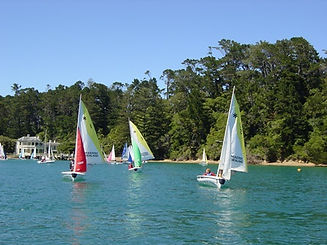
Kawau Camp, 2003

Algies Bay, 2014
In 1987, responsibility for facilitating the contest was vested in Yachting New Zealand (then NZYF). From 2004, the event has been run by the New Zealand Team Sailing Association (NZTSA) under the Yachting New Zealand umbrella, consistent with other yacht classes.
The racing format has continued to evolve. Courses developed from the original triangle, to a box course, and more recently to a right-hand S course, allowing for more continuous and engaging racing. In the early years, there were no umpires, resulting in lengthy protest hearings after racing. Over time, this improved significantly.
On-the-water protest panel observers were introduced, followed by on-the-water umpiring in 1992, alongside the earlier adoption of a no-appeals protest policy, bringing faster, fairer decisions.
When Sunburst yachts were used, fairness was maintained by only using boats built from the same mould. When the hull mould changed, NZTSA began searching for a suitable replacement that was also a recognised youth class and supported by Yachting New Zealand.
The 420 class was selected. NZTSA now supplies the majority of the 420s used for team sailing. These boats were originally purchased for the ISAF Team Racing World Championships, held in Auckland in 2003, and are now held in trust by the association for team sailing events. Coloured sails, funded by sponsors, are also provided to keep competition as even as possible.
Up until 2003, schools qualified through regional trials across the original 17 regions, with a Cook Islands team also invited. In 1994, a new initiative was introduced to increase female participation. Three new qualifying zones were created, allowing girls’ teams to qualify directly for nationals and expanding the finals to 22 teams. Margaret and Jim Park, with Jim serving as Chief Umpire for many years, donated a trophy for the top girls’ team.
Despite this, participation declined in the late 1990s and early 2000s due to uncertainty around regional qualification and the costs of attending nationals, with team numbers dropping to around 13 teams.
In 2004, the championship adopted an open format, and more recently teams have been seeded into ranked fleets racing across two courses, increasing participation and competitiveness.
Originally, the Nationals rotated between two years in the North Island followed by one year in the South Island. Over time, venues ranged from Dunedin to Whangarei, with more than ten centres hosting the event. As team numbers increased and logistics became more complex, the event began focusing on fewer venues—most notably Taupō and Algies Bay—to improve efficiency and consistency.
Today, the National Secondary Schools Team Sailing Championships regularly feature more than 30 teams, representing over 50 secondary schools from across New Zealand—a testament to the strength, history, and continued growth of the sport.